
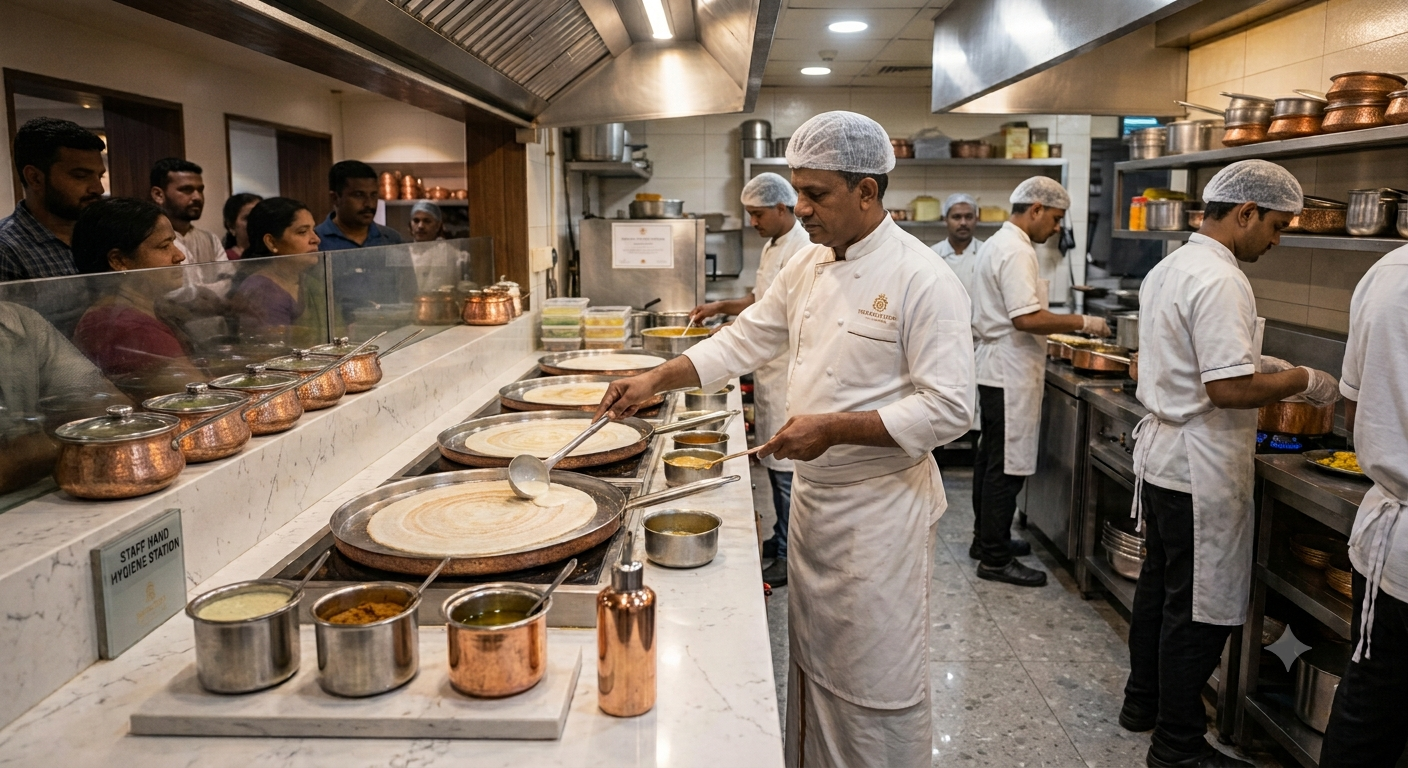
Opening a South Indian restaurant may begin with a simple menu of dosa, idli, vada, sambar and chutneys, but the kitchen behind that menu has to handle several processes at once. Rice and dal need to be washed, soaked and ground. Batter needs to be prepared and managed properly. Idlis have to be steamed in batches, dosa plates need to remain ready for continuous cooking, and sambar, curries and accompaniments have to be prepared alongside them.
As customer volumes increase, these processes become more demanding. A kitchen that works comfortably for a small outlet may quickly become difficult to manage during a busy breakfast service.
This is why a South Indian restaurant kitchen setup needs to be planned around the way food is prepared, cooked, stored and served. The right layout and equipment can reduce unnecessary movement, improve service speed and make it easier for the kitchen team to maintain consistent food quality.
Understanding the Operational Requirements of a South Indian Restaurant
South Indian restaurant kitchens have some very specific operational demands. The exact requirements will depend on the menu, seating capacity, expected covers and service format, but certain processes are common across most commercial kitchens serving South Indian food.
High-Volume Breakfast Service
Breakfast can be one of the busiest periods for a South Indian restaurant. Orders for idli, dosa, vada, pongal, upma and other breakfast dishes can arrive within a short period, creating pressure on preparation and cooking stations.
The kitchen therefore needs to support continuous production rather than isolated cooking. Batter should be accessible to the dosa station, steamed products need to move efficiently towards service, and accompaniments such as sambar and chutneys should be available without creating congestion.
A well-planned commercial kitchen for a South Indian restaurant should allow staff to work quickly without constantly crossing through other work areas.
Multiple Preparation Processes
A considerable amount of work happens before the first order reaches the cooking station.
Rice and pulses may need washing, soaking and grinding. Vegetables have to be cleaned and cut. Chutneys need to be prepared, sambar ingredients portioned and batter stored under suitable conditions.
This means preparation areas need enough workspace and should be positioned logically in relation to storage and cooking zones. If preparation is treated as an afterthought, staff can end up carrying ingredients repeatedly across the kitchen, wasting both time and floor space.
Live Cooking and Service Requirements
Dosa is often prepared to order, making the dosa station one of the most visible and active parts of a South Indian restaurant kitchen.
The dosa counter setup should provide enough working space for the cooking surface, batter containers, oil, utensils, plates and finished orders. At the same time, it should be positioned so that cooks can work continuously without interfering with other kitchen activities.
For larger restaurants, multiple cooking surfaces may be required to prevent the dosa station from becoming a bottleneck during peak hours.
Diverse Menu Offerings Beyond Dosa and Idli
South Indian cuisine extends far beyond its most recognisable dishes. Depending on the concept, a restaurant may serve vada, uttapam, pongal, upma, rice dishes, curries, fried snacks, meals and regional specialities.
This affects the equipment mix.
A restaurant serving only breakfast items will have different requirements from a full-service South Indian restaurant offering lunch and dinner. The kitchen plan should therefore be based on the actual menu rather than a generic list of restaurant equipment.
Key Areas in a South Indian Restaurant Kitchen Layout
A practical South Indian kitchen layout should follow the movement of ingredients from receiving and storage through preparation, cooking and service.
The objective is simple: ingredients and staff should move through the kitchen with as few unnecessary crossings as possible.
Dry and Cold Storage Area
Storage is the starting point of the kitchen workflow.
Dry ingredients such as rice, lentils, flour, spices and packaged supplies need organised dry storage. Perishable ingredients such as vegetables, dairy products, coconut and other chilled items require appropriate refrigeration.
Storage should also be positioned so that frequently used ingredients can be accessed without disrupting cooking or preparation.
For larger operations, vertical refrigeration can make better use of available floor space while keeping ingredients organised and accessible.
Preparation Zone
The preparation area is where vegetables are cleaned and cut, ingredients are portioned and components are prepared before cooking.
This zone needs durable work surfaces, adequate sinks and enough room for staff to work without crowding one another. It should ideally be located between storage and the cooking area.
Keeping preparation organised can have a noticeable effect during busy services because cooks are not forced to stop cooking to complete basic preparation tasks.
Batter Preparation Area
Batter deserves its own consideration in a South Indian restaurant.
The preparation process involves washing and soaking ingredients, grinding them and transferring the mixture into suitable containers for fermentation and storage. The scale of production determines the capacity and type of grinding equipment required.
A dedicated batter preparation area can help keep wet grinding activities separate from other food preparation tasks while making cleaning easier.
Cooking and Production Area
This is where most of the heat-producing equipment is concentrated.
Depending on the menu, this area may include dosa bhattis, cooking ranges, burners, steamers, tilting pans, fryers and other cooking equipment.
The arrangement should give each cook enough working space while maintaining a logical relationship between cooking, ingredient access and service.
Ventilation is particularly important in this area because dosa cooking, frying and other high-heat processes can generate considerable heat, smoke and grease.
Service and Dispatch Area
Once food is cooked, it needs to leave the kitchen quickly.
The service or dispatch area should be close enough to the cooking stations to reduce the distance finished dishes travel. At the same time, it should be separated from raw preparation wherever possible.
For restaurants with a high takeaway or delivery volume, the dispatch area may also need dedicated packing space.
Cleaning and Dishwashing Area
Cleaning should have a defined place in the kitchen rather than being squeezed into whichever space is available.
A separate dishwashing zone helps prevent used utensils and cookware from interfering with food preparation. Sinks, drainage, waste handling and storage for cleaned utensils should all be considered during the planning stage.
Essential Equipment for a South Indian Restaurant Kitchen
The equipment required for a South Indian restaurant depends on menu complexity, production volume, available space and the expected number of customers.
Rather than buying every possible machine, restaurants should identify the processes that need to happen every day and select equipment that can support those processes reliably.
(The following products are from Alister, available in standard sizes. We also customize the dimensions and specifications based on your specific requirements. Dosa tawas can be customized for the appropriate thickness and heat distribution to help achieve the desired dosa texture and crispness, while idli steamers can be designed around the required tray configuration and steaming process for consistent idli production. For chefs, franchises and commercial kitchen projects that follow strict measurements in inches or millimetres, we fabricate the equipment to match the required dimensions and kitchen layout.)
Batter Preparation Equipment
Wet grinders are essential for restaurants preparing dosa and idli batter in-house. The capacity should be selected based on daily production requirements and available kitchen space.
- Tilting Wet Grinder 30 Ltrs: Suitable for restaurants that prepare large batches of batter regularly. Its tilting mechanism makes it easier to transfer the prepared batter, which can be particularly useful during high-volume production.
- Wet Grinder 10L: A practical option for smaller restaurants or kitchens with moderate batter requirements. Its smaller capacity can fit more easily into compact preparation areas while supporting regular dosa and idli batter production.
Idli and Steam Cooking Equipment
Idli production requires reliable steaming capacity, especially during busy breakfast hours. Choosing the right number of trays helps the kitchen maintain a steady production cycle.
- Gas Electric Idli Steamer 6 Trays SS Body: A six-tray steamer designed for regular commercial idli production. The stainless steel body makes it suitable for demanding kitchen environments and frequent use.
- Butler Gas Based Steamer with 6 Trays: A gas operated steamer designed for high volume idli production, with six trays that allow larger batches to be steamed at a time. It is well suited to restaurants handling busy breakfast services and regular bulk production.
- Aluminium Idli Steamer 12 Trays: Designed for small volume idli production, this steamer allows multiple idlis to be prepared in a single batch. It is a suitable choice for smaller restaurants, cafés and food businesses with moderate breakfast requirements.
Dosa and Live Cooking Stations
The dosa station needs enough cooking surface and workspace to support continuous preparation. The size of the bhatti should be matched to order volumes and the number of cooks working at the station.
- Gas Dosa Bhatti 4 Ft: A four-foot dosa bhatti provides a spacious cooking surface for restaurants handling a high volume of dosa orders. Its larger format allows multiple dosas to be prepared efficiently during busy periods.
- SS High Pressure LPG Stove Dosa Bhatti 15 Inch: A compact option for restaurants with limited kitchen space or lower dosa production requirements. Its smaller footprint makes it easier to incorporate into a compact cooking line.
- SS High Pressure LPG Stove Dosa Bhatti 36 Inch: The 36-inch cooking surface provides more room for preparing multiple dosa orders. It can be considered for restaurants that need greater cooking capacity while maintaining a dedicated dosa station.
- Table Top Gas Dosa Bhatti with 3 Side Skirting 31 Inch: This tabletop model can be integrated into a counter-based dosa station. Its three-side skirting helps define the cooking area and can make the setup more organised.
Cooking Equipment for Curries and Accompaniments
Dosa and idli are supported by a range of accompanying dishes, including sambar, rasam, curries and fried preparations. The cooking line should therefore include equipment suited to the restaurant’s complete menu.
- Three Burner Gas Range with Splash Back: This three-burner LPG cooking range provides a dedicated cooking station for preparing sambar, curries, rasam and other dishes simultaneously. Its stainless steel body and splashback make it suitable for regular use in a commercial kitchen.
- Butler Induction Deep Fryer IDF-08: With an 8-litre capacity and a temperature range of 60°C to 190°C, this induction fryer can support the preparation of vada and other fried accompaniments. Its stainless steel body, touch controls and LED timer also make it practical for controlled frying during service.
- Pulverizer / Gravy Machine 1HP: This 1HP pulverizer can be useful for preparing smooth gravies, pastes and other ingredients used across South Indian dishes. Its full stainless steel body, safety switch and five interchangeable jalis allow it to support different preparation requirements.
- SS Bain Marie Floor Model for 4 GN Pans 1/1: This floor-model bain marie can hold four 1/1 GN pans, making it useful for keeping prepared sambar, gravies, curries and other accompaniments ready for service. Its four-pan capacity can help organise multiple preparations at a busy service station.
Refrigeration and Storage Solutions
Refrigeration needs to provide sufficient capacity while keeping frequently used ingredients accessible to the kitchen team.
- Hoshizaki SS Four Door Vertical Chiller HRW 127 MS4: A four-door vertical chiller provides substantial refrigerated storage while making efficient use of vertical space. It can be used for storing vegetables, dairy products, prepared ingredients and other chilled supplies.
- Reach In Freezer GN 1350 BTM: Provides dedicated frozen storage for ingredients that need to be kept at freezing temperatures. Its reach-in format allows kitchen staff to access stored products without moving through other work areas.
- Hoshizaki Prep Counter Cold Bain Marie Three Door RTSW 137 MS4 GNTE: Combines refrigerated storage with a preparation counter, making it useful for active preparation and service areas. It allows ingredients to remain close to the workstation while maintaining chilled storage.
Stainless Steel Workstations and Utility Equipment
Worktables, sinks and storage systems provide the basic infrastructure needed to keep a commercial kitchen organised and functional.
- SS Storage Rack 30 Inch: Provides organised storage for ingredients, containers and kitchen supplies. Its vertical format can help maximise storage capacity where floor space is limited.
- SS Rack Trolley for PVC Crates: Designed for storing and moving PVC crates within the kitchen. It can make ingredient handling more organised and reduce repeated manual movement.
- SS Pot Rack 48 Inch: Provides dedicated storage for pots and larger cookware. Positioning the rack close to the cooking area can make frequently used cookware easier for staff to access.
- Entry Table with Sink with Splash Back: Combines a work surface with an integrated sink and splashback. It can support preparation and washing activities while helping keep water contained within the workstation.
- SS Cabinet Work Table 5 Ft: Provides a five-foot working surface along with enclosed storage underneath. It is useful for kitchens that need additional preparation space without giving up valuable storage capacity.
Workflow Considerations for Efficient South Indian Restaurant Operations
A kitchen can have good equipment and still perform poorly if the workflow has not been planned properly.
The best restaurant kitchen planning considers what staff actually do during a typical service and arranges the equipment around those movements.
Minimizing Staff Movement
Every unnecessary step adds up during a busy service.
If a cook has to repeatedly walk across the kitchen for batter, oil, utensils or plates, the problem becomes much more noticeable during peak hours.
Frequently used ingredients, tools and equipment should therefore be positioned close to the relevant workstation.
Separating Preparation and Cooking Areas
Raw preparation and cooking have different requirements.
Keeping these activities reasonably separated helps reduce congestion and makes the kitchen easier to organise and clean. It also allows preparation staff to work without constantly crossing paths with cooks handling hot equipment.
The exact separation will depend on the available space, but the principle should remain the same: each area should have a clear purpose.
Managing Peak Breakfast and Dinner Rushes
Kitchen planning should be based on the busiest period rather than an average day.
A restaurant that serves 30 customers comfortably during a quiet afternoon may face a very different situation when dozens of breakfast orders arrive within a short period.
Equipment capacity, cooking surface, batter availability, refrigeration and dispatch space should therefore be assessed against peak demand.
Ensuring Smooth Service Flow
The final stage of the workflow is getting food from the kitchen to the customer.
Cooking stations should connect logically to plating and dispatch. Finished dishes should not have to pass through raw preparation or dishwashing areas before reaching service.
For takeaway-focused restaurants, packing and dispatch should also have enough dedicated space to prevent delivery orders from interfering with dine-in service.
Common Challenges in a South Indian Restaurant Kitchen
Even a carefully planned kitchen can face operational challenges. Identifying them before installation makes it easier to design practical solutions.
Managing Batter Production and Storage
Batter production requires planning because demand can vary considerably throughout the day.
Producing too little can interrupt service, while producing excessive quantities can create unnecessary storage requirements and wastage.
The grinding capacity, fermentation process, storage containers and refrigeration requirements should therefore be considered together.
Handling High Customer Volumes
High customer volumes put pressure on every part of the kitchen.
The issue may not always be a lack of cooking equipment. A restaurant can have enough burners but still experience delays because preparation, plating or dispatch cannot keep up.
The entire workflow needs to be evaluated when determining equipment capacity.
Maintaining Consistent Food Quality
Consistency becomes more difficult when production volumes increase.
Commercial equipment can help standardise certain processes, but staff training, ingredient measurement, cooking procedures and regular equipment maintenance remain equally important.
The goal is to create a kitchen where cooks can repeat the same process efficiently throughout the service.
Ventilation Around Dosa and Frying Stations
Dosa cooking, frying and other high-heat activities generate heat, vapour and grease.
Ventilation should therefore be planned alongside the cooking equipment rather than added later. The position and size of exhaust systems should account for the heat-producing equipment and the kitchen’s overall layout.
Good ventilation also makes the working environment more comfortable for kitchen staff.
Space Constraints in Urban Locations
Many restaurants have to work within compact commercial spaces.
The solution is not necessarily to fit more equipment into a smaller area. It is to prioritise equipment according to the menu and make better use of vertical and multi-purpose storage.
A carefully planned compact kitchen can often perform better than a larger kitchen with poor workflow.
Conclusion
Planning a South Indian restaurant kitchen setup is ultimately about creating a space where every stage of food production works in the right sequence. Batter preparation, steaming, dosa cooking, curry production, storage, cleaning and service all need to connect without creating unnecessary movement or bottlenecks.
The right South Indian kitchen layout and equipment can make a significant difference to how efficiently the kitchen performs, particularly during busy breakfast and dinner services. Equipment capacity, workspace, ventilation, storage and staff movement should therefore be considered together from the planning stage.
For restaurants, the goal is not simply to fit more equipment into the available space, but to create a kitchen that can consistently support the menu, the expected volume of orders and future growth. Alister’s range of commercial kitchen equipment can support these requirements, from wet grinders and idli steamers to dosa bhattis, refrigeration and stainless steel workstations.
With thoughtful restaurant kitchen planning and the right equipment in place, a South Indian restaurant can build a kitchen that is efficient during service, practical for staff and capable of supporting the business as it grows.