
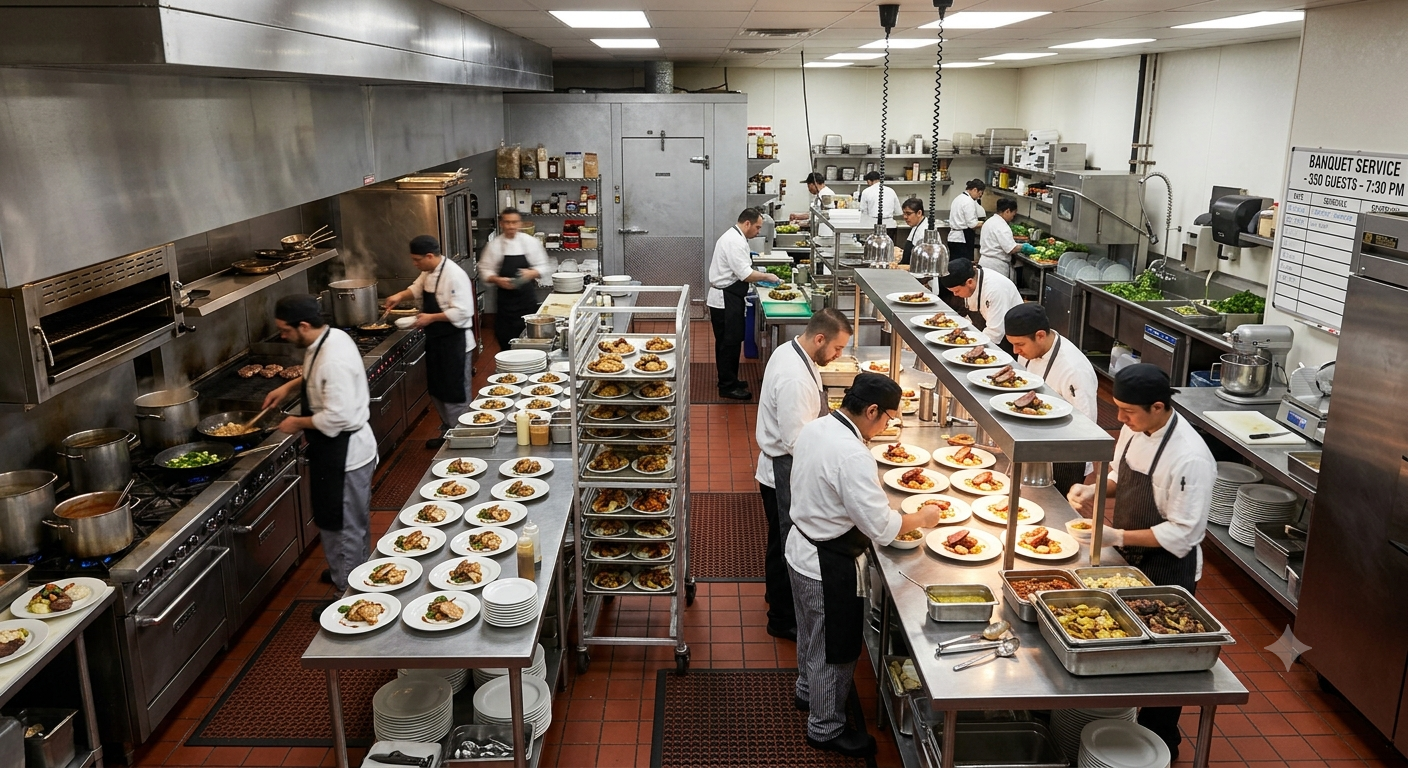
When hundreds of guests are served within minutes, there’s no room for error. Every workstation, every piece of equipment, and every step in the workflow must work together seamlessly to keep food moving from preparation to service without delays. That’s what makes banquet kitchen planning fundamentally different from designing a traditional restaurant kitchen.
Whether it’s a grand wedding, a corporate conference, or a large-scale social event, banquet kitchens are built to handle high-volume food production while maintaining consistency, quality, and efficiency. A well-planned kitchen not only streamlines operations but also enables staff to deliver exceptional service even during the busiest events.
In this guide, we’ll explore what sets banquet kitchens apart, the key factors to consider during planning, and the layout requirements that help food service businesses operate efficiently during large-scale events.
How Is a Banquet Kitchen Different from a Restaurant Kitchen?
Although both kitchens serve the same purpose: preparing quality food, their operational requirements are significantly different.
| Feature | Banquet Kitchen | Restaurant Kitchen |
| Food Production | Batch cooking for large groups | Made-to-order cooking |
| Service Style | Fixed event timings | Continuous service |
| Menu | Pre-planned and limited | Extensive à la carte menu |
| Equipment | Heavy-duty, high-capacity | Mixed-capacity equipment |
| Storage Requirements | Large ingredient storage | Moderate storage |
| Workflow | High-volume production | Individual order preparation |
A hotel banquet kitchen must be designed to manage large food volumes efficiently while maintaining consistency across every dish served.
Key Considerations When Planning a Banquet Kitchen
Successful banquet kitchen planning starts with understanding the operational needs of the venue. Every banquet facility differs in terms of guest capacity, menu offerings, and service style, making it essential to design a kitchen that supports both current operations and future growth.
Guest Capacity and Event Volume
The first step in planning a banquet kitchen is determining the number of guests the facility is expected to serve. A venue hosting 300 guests has vastly different equipment and space requirements compared to one catering for 2,000 guests.
It’s equally important to consider whether the venue will host multiple events simultaneously. Hotels and convention centres often operate several banquet halls at once, requiring a kitchen capable of managing multiple service schedules without disrupting workflow.
Designing for peak demand rather than average occupancy helps ensure the kitchen can maintain efficiency even during busy seasons.
Menu Complexity
The type of menu being served has a direct impact on the overall banquet kitchen design. A simple buffet requires different equipment and preparation areas than a multi-course plated dinner or a wedding menu featuring several regional and international cuisines.
Live cooking stations, dessert counters, and specialty cuisines may require additional preparation space, dedicated equipment, and separate workstations. Understanding menu complexity during the planning stage helps optimise both kitchen layout and equipment selection.
Service Style
Different event formats demand different kitchen operations.
For example:
- Buffet service requires efficient food holding and replenishment systems.
- Plated service demands precise coordination between cooking, plating, and dispatch teams.
- Live cooking stations require dedicated preparation areas and specialised equipment.
- Cocktail receptions focus on continuous production of appetisers and finger foods.
The chosen service style influences staffing requirements, workflow, and the overall banquet kitchen layout.
Workflow and Staff Movement
One of the biggest challenges in a banquet food production kitchen is managing the movement of people, ingredients, and finished dishes without creating congestion.
An efficient workflow should allow ingredients to move seamlessly from receiving and storage to preparation, cooking, plating, and service. Likewise, dirty utensils should travel directly to the washing area without crossing food preparation zones.
Well-planned staff movement reduces delays, improves communication, and minimizes the risk of cross-contamination.
Future Scalability
Many banquet facilities expand over time by increasing event capacity, introducing new menu offerings, or adding additional function halls.
Planning for future growth ensures the kitchen can accommodate additional equipment, increased storage, and larger production volumes without requiring major structural modifications. Investing in scalable commercial kitchen planning helps businesses adapt to changing customer demands while protecting their long-term investment.
Designing an Efficient Banquet Kitchen Layout
An efficient banquet kitchen layout is built around one objective, ensuring food moves smoothly through every stage of production while allowing staff to work safely and efficiently. Clearly defined kitchen zones reduce unnecessary movement, improve coordination, and support consistent food quality during large events.
-
Receiving and Storage Area
Every operation begins with receiving fresh ingredients. This area should provide sufficient space for inspecting deliveries, checking product quality, and organising inventory before ingredients are transferred to dry or cold storage. Proper storage practices help preserve food quality while reducing waste.
-
Cold Storage and Refrigeration Zone
A dedicated refrigeration area is essential for storing perishable ingredients at safe temperatures. Walk-in coolers, freezers, and reach-in refrigerators should be strategically positioned near preparation areas to minimize unnecessary movement while maintaining the cold chain throughout food production.
-
Food Preparation Area
This is where ingredients are washed, cut, marinated, and prepared before cooking. Preparation zones should include stainless steel worktables, vegetable preparation equipment, sinks, and adequate workspace to accommodate multiple chefs during peak production hours.
-
Cooking Area
The cooking zone serves as the heart of the kitchen and should be equipped with high-capacity cooking equipment capable of supporting batch production. Equipment placement should allow chefs to move efficiently between preparation, cooking, and holding areas while maintaining safe working conditions.
-
Hot Holding Area
Once food is cooked, maintaining its quality until service begins becomes just as important as the cooking process itself. The hot holding area is designed to keep prepared food at safe serving temperatures without compromising its taste, texture, or appearance.
In a banquet food production kitchen, service often begins only after every dish is ready. This means food may need to be held for a short period before being transferred to buffet stations or plated for guests. Equipping this zone with bain-maries, heated holding cabinets, and insulated food transport systems helps maintain consistency throughout service while ensuring compliance with food safety standards.
-
Plating and Dispatch Area
The plating and dispatch area acts as the final checkpoint before food reaches the banquet hall. It is where dishes are portioned, garnished, organised, and handed over to the service team.
Since banquet service is highly time-sensitive, this area should be spacious enough to accommodate multiple staff members working simultaneously. Positioning it close to both the cooking area and service exit reduces unnecessary movement and helps ensure every plate reaches guests at the right temperature.
For venues hosting multiple events, separate dispatch counters can further improve efficiency by preventing service delays and reducing the chances of order mix-ups.
-
Dishwashing and Cleaning Area
An efficient cleaning zone is essential for maintaining hygiene and supporting continuous kitchen operations. During large events, hundreds of plates, serving dishes, utensils, and cooking equipment return to the kitchen within a short span of time, making a well-planned dishwashing area critical.
This zone should be separated from food preparation and cooking areas to prevent cross-contamination. Commercial dishwashers, wash stations, drying racks, and designated waste disposal points help streamline cleaning operations while ensuring the kitchen is ready for the next service.
Essential Equipment for a Banquet Kitchen
The success of a banquet kitchen depends not only on its layout but also on selecting equipment that can support large-scale food production without slowing down operations. Every piece of equipment should match the expected guest capacity, menu requirements, and service style while contributing to an efficient workflow.
Food Preparation Equipment
Preparation is often the most labour-intensive stage in banquet operations. Having the right equipment allows kitchen teams to process large quantities of ingredients quickly and consistently before cooking begins.
Essential preparation equipment includes:
- Stainless steel work tables
- Vegetable preparation machines
- Food processors
- Planetary mixers
- Preparation sinks
- Mobile workstations
These tools help reduce manual effort, improve consistency, and prepare ingredients efficiently during peak production hours.
Cooking Equipment
Cooking equipment forms the backbone of any hotel banquet kitchen. Unlike restaurant kitchens, banquet kitchens require high-capacity equipment capable of producing large batches of food while maintaining consistent quality.
Commonly used equipment includes:
- Commercial cooking ranges
- Tilting boiling pans
- Bratt pans
- Combi ovens
- Steam cooking equipment
- Bulk rice cookers
- Deep fryers
Combi ovens are particularly valuable because they combine steaming, baking, roasting, and convection cooking in a single unit, allowing chefs to prepare multiple dishes efficiently while saving valuable kitchen space.
Refrigeration Equipment
Maintaining ingredient freshness is essential in a large scale catering kitchen, especially when preparing meals for large events.
A well-equipped refrigeration zone typically includes:
- Walk-in freezers
- under counter refrigeration
- Reach-in refrigerators
- Blast chillers
These systems ensure ingredients remain at safe temperatures while supporting organized storage and easy access during food preparation.
Food Holding and Service Equipment
Food quality doesn’t end once cooking is complete. Holding equipment plays a vital role in ensuring meals remain fresh and ready for service.
Key equipment includes:
- Bain-maries
- Heated holding cabinets
- Buffet counters
- Food Warmers
These solutions help maintain serving temperatures while ensuring a steady flow of food throughout the event.
Cleaning and Hygiene Equipment
Maintaining hygiene is essential in high-volume food service operations. Efficient cleaning equipment enables kitchens to process large quantities of utensils and cookware without disrupting production.
This category typically includes:
- Commercial dishwashers
- Three-compartment sinks
- Handwashing stations
- Pot wash units
- Grease traps
Well-designed cleaning systems contribute to better hygiene standards and ensure kitchen operations continue smoothly between events.
Common Challenges in Banquet Kitchen Operations
Even a well-equipped kitchen can experience operational challenges if the layout and workflow are not designed to handle large-scale service efficiently.
-
Peak-Hour Bottlenecks
During service, multiple teams often work simultaneously across preparation, cooking, plating, and dispatch. Poorly planned layouts can create congestion, slowing down production and increasing service delays.
-
Delayed Food Dispatch
When plating stations and dispatch areas are not positioned strategically, completed dishes spend more time waiting before reaching guests. This can affect both food quality and the overall dining experience.
-
Limited Storage Capacity
Insufficient dry storage or refrigeration space often results in overcrowded shelves, inefficient inventory management, and unnecessary movement during food preparation.
-
Workflow Inefficiencies
Poor placement of equipment forces staff to travel longer distances between workstations, increasing preparation time and reducing overall productivity.
-
Equipment Under-Capacity
Using equipment that doesn’t match the venue’s production requirements can create bottlenecks during peak events, leading to slower service and inconsistent food quality.
-
Labour Coordination Challenges
Large banquet operations require multiple teams to work in sync. Without clearly defined work zones and efficient kitchen flow, communication becomes difficult, affecting both speed and service quality.
Why Professional Banquet Kitchen Planning Matters
Every banquet venue has its own operational requirements. A hotel hosting multiple weddings in a day will have different production needs than a convention center managing corporate conferences or a standalone banquet hall specializing in social events. That’s why a standard kitchen layout rarely delivers the efficiency required for high-volume catering.
Professional banquet kitchen planning begins with understanding the venue’s capacity, menu offerings, service style, and future growth plans. These insights help determine the ideal kitchen layout, equipment specifications, workflow, storage capacity, and utility requirements before construction begins.
At Alister, we specialize in designing tailored commercial kitchen solutions for hotels, banquet halls, convention centers, and event venues. From optimising the banquet kitchen layout and selecting high-performance banquet kitchen equipment to creating efficient workflows, our team delivers turnkey solutions that support seamless operations, food safety, and long-term business growth.
Conclusion
The success of a banquet is measured in moments that guests remember, but those moments are made possible by everything that happens behind the kitchen doors. A kitchen that’s planned with purpose creates the consistency, efficiency, and reliability needed to deliver every event at its best.
For businesses looking to build kitchens that perform as exceptionally as the events they serve, Alister delivers customized commercial kitchen solutions that bring together intelligent planning, high-quality equipment, and lasting operational value.
FAQs
1. What is the ideal size of a banquet kitchen?
The ideal size depends on the venue’s guest capacity, menu complexity, and service style. Rather than following a fixed size, banquet kitchens should be planned to accommodate production volume, storage needs, staff movement, and future expansion.
2. What is the most important factor in banquet kitchen planning?
While several factors influence the design, workflow is often the most critical. An efficient workflow ensures ingredients, staff, and finished dishes move smoothly through the kitchen, reducing delays and improving productivity during large events.
3. Can one banquet kitchen serve multiple event halls?
Yes. A well-designed banquet kitchen can support multiple banquet halls simultaneously, provided it has sufficient production capacity, dedicated dispatch areas, and equipment designed to handle peak demand.
4. How do banquet kitchens maintain food quality during service?
Banquet kitchens rely on equipment such as combi ovens, blast chillers, bain-maries, and heated holding cabinets to maintain food quality, temperature, and consistency from cooking through to service.
5. When should banquet kitchen planning begin?
Kitchen planning should begin during the early stages of a project, before construction starts. This allows the layout, utilities, equipment, and workflow to be integrated into the building design, helping avoid costly modifications later.
6. Why should businesses work with professional commercial kitchen consultants?
Professional consultants evaluate operational requirements, production capacity, workflow, and equipment needs to create kitchens that are efficient, compliant, and built for long-term performance. This ensures the kitchen supports both current operations and future business growth.